 Bytetally
Stats app alternative: when the network module isn't enough
Last updated: 21 July 2026
Stats is one of the nicest free things on the Mac: an open-source menu-bar monitor with modules for CPU, GPU, sensors and network, whose network widget shows your current speed and top processes. If that's all you need, keep it. But people searching for a Stats alternative for network monitoring usually hit the same wall: live numbers disappear the moment you look away. There's no long-term record of which app used what, no budget to stay under, and no way to act on what you see.
The short answer: Bytetally is a network monitor for macOS that goes where a live readout can't: it keeps a long-term per-app record of upload and download, sets monthly/weekly/daily data caps with an independent budget per Wi-Fi network, alerts you at 80%/100% or on unusual uploads, and can throttle or block any app. All analysis stays on your Mac.
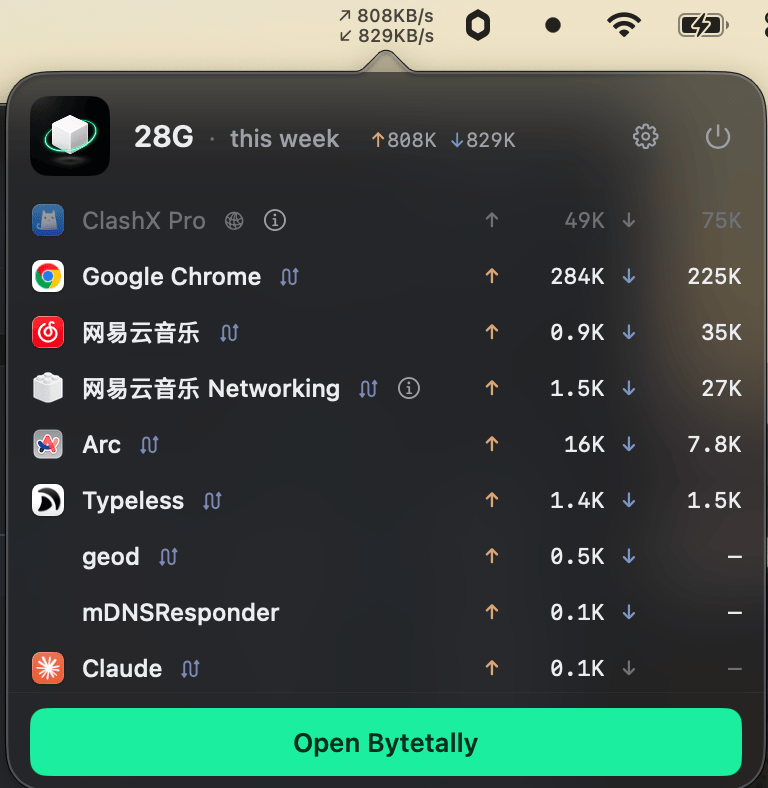
Live ↑↓ speed in the menu bar, and a popover that remembers: this week's usage, ranked per app.
Bytetally vs Stats at a glance
| Capability | Bytetally | Stats |
|---|---|---|
| Core focus | Network usage: account, budget, control | Whole-system dashboard: CPU, GPU, sensors, network |
| Live speed in the menu bar | ✓ ↑↓ rates, switchable to today's usage or cap % | ✓ Network module |
| Per-app usage right now | ✓ Live rate + totals, upload and download separated | Top processes by current rate |
| Long-term per-app history | ✓ Any date range, hour-by-day heatmap | — |
| Data caps with alerts | ✓ Monthly / weekly / daily, 80%·100%·custom thresholds | — |
| Per-Wi-Fi budgets | ✓ Independent cap per network | — |
| Unusual-upload alerts | ✓ Notifies when an app's upload surges | — |
| Throttle or block an app | ✓ Speed limits, one-click disconnect, auto-response | — |
| VPN / proxy attribution | ✓ Traces traffic back to the real app | — |
| Export | ✓ CSV / JSON | — |
| CPU / GPU / sensor modules | — | ✓ Its home turf |
| Price | Free core; Pro trial, then subscription or lifetime | Free, open source |
A speedometer vs an odometer
Stats' network module is a speedometer: it tells you how fast data is moving right now, and which processes are moving it. That's genuinely useful — and it's why so many Macs have it installed. What it can't tell you is anything about the past: which app quietly used 12 GB last week, whether today is on track to blow through your hotspot allowance, or why your monthly quota vanished three days early.
Bytetally is built around exactly those questions. Its measurement runs through a macOS Network Extension, so every byte is attributed to the app that caused it — even traffic that flows through a VPN or a local proxy like ClashX, and even command-line tools, which get merged into their host app. From there:
- Account. Every app's upload and download is recorded separately: live rate, totals for the period, a 7-day trend, and — with Pro — history for any date range plus an hour-by-day heatmap.
- Budget. Set a monthly, weekly or daily cap, and give each Wi-Fi network its own independent budget (hotspots, hotel Wi-Fi, metered plans). Bytetally notifies you at 80%, 100% or any threshold you choose, and warns when an app's upload suddenly surges.
- Act. Right-click any app: Disconnect, Limit speed or Set quota. When a cap runs out, the overage auto-response can block or throttle automatically.
Local traffic between devices on your own network is excluded from the count, so backups to a NAS don't eat your "internet" budget — the numbers you budget against are the numbers your ISP bills.
When Stats is the better choice: if what you want is a free, open-source, multi-module system monitor — CPU load, GPU, fan speeds, temperatures, plus a network speed readout — Stats does that beautifully, and Bytetally doesn't try to. Keep Stats for the system dashboard.
Reach for Bytetally when the network module stops being enough: when you need to know which app, how much, over what period — and want a cap, an alert or a speed limit standing behind the answer. The two run happily side by side.
Adding Bytetally next to Stats: a 5-minute setup
- Install Bytetally from the Mac App Store and approve the Network Extension when macOS asks (Bytetally is fully sandboxed and App Store reviewed).
- If you keep Stats' network widget, you'll have two speed readouts — either is fine, but most people let Bytetally take over the network slot and keep Stats for CPU and sensors.
- After a day, open the Overview: this period's usage, the 7-day trend and your top apps by traffic. The surprise data-eater is usually obvious immediately.
- Set a data cap that matches your plan — and an independent one for your hotspot — then let the threshold alerts and auto-response do the watching for you.
Frequently asked questions
Does Bytetally replace all of Stats, or just the network part?
Just the network part. Stats covers CPU, GPU, sensors and more; Bytetally focuses entirely on network usage. Many people run both side by side: Stats for system dashboards, Bytetally for data accounting, caps and control.
Can Bytetally show live network speed in the menu bar like Stats?
Yes. Bytetally keeps a live ↑↓ speed readout in the menu bar, and its popover lists this period's usage per app. With Pro you can switch the menu bar display to today's usage or your data-cap percentage instead.
Does Bytetally keep usage history after a restart?
Yes. Per-app totals for the current period and a 7-day trend are free. Pro unlocks history for any date range plus an hour-by-day heatmap, so you can see exactly when and where your data went.
Is my traffic data uploaded anywhere?
No. All analysis happens on-device. There is no account, and the only network request the app makes is purchase-receipt validation.
Is Bytetally free?
Core monitoring is free. Pro features such as data caps, per-app control and full history come with a free trial, then a subscription or a one-time lifetime purchase.
Related pages
Keep the dashboard. Add the accounting.
Per-app tracking free forever. Caps, throttling and full history with a free trial.
Download Free on the Mac App StoremacOS 14 Sonoma or later · 100% on-device · No account